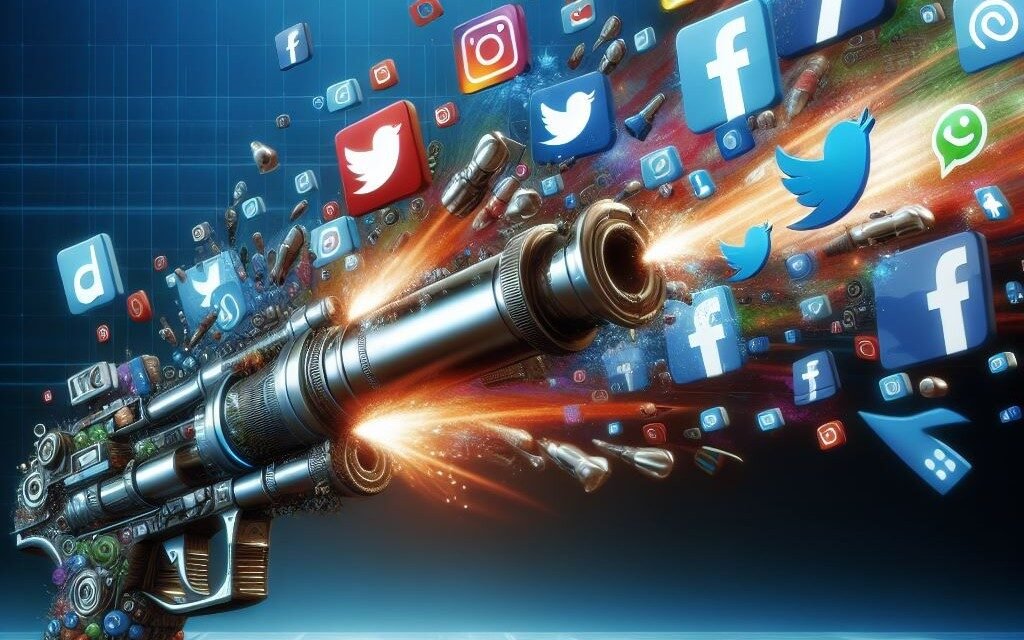
Introduction: The New Battlefield Is Also Digital
For decades, Arab public opinion was shaped primarily by what people saw on television, heard on radio, read in newspapers, or experienced directly in their communities.
Wars were followed through television correspondents. Political speeches were broadcast from national capitals. Newspapers determined much of the daily agenda, while governments and major media organizations exercised considerable influence over what citizens could see and discuss.
That environment has fundamentally changed.
Today, a battlefield can be thousands of kilometres away and still enter an Arab household within seconds through a smartphone screen.
A missile strike in Gaza, an explosion in Beirut, a statement from Washington, an Israeli military operation, a speech by an Arab leader, or a protest in a European capital can become part of the regional public conversation almost instantly.
The result is not simply that Arabs are consuming more news online.
The deeper transformation is that Arab citizens increasingly participate in producing, interpreting, amplifying and contesting the news themselves.
The distinction between journalist, commentator, activist, witness and ordinary social-media user has become increasingly blurred.
The transformation is occurring at a moment of extraordinary regional upheaval. The war in Gaza, wider regional confrontations, changing relations between the Arab states and major global powers, economic pressures and political uncertainty have created an environment in which public opinion is highly sensitive to images, narratives and perceptions of injustice.
The latest Arab Barometer findings show that Gaza has become a major lens through which people across the Middle East and North Africa evaluate regional and international actors. Its Wave IX surveys, conducted across nine countries between September 2025 and May 2026, are based on nationally representative face-to-face research and more than 10,000 interviews.
At the same time, the global information environment is moving rapidly toward platforms, video and individual creators. The Reuters Institute’s 2026 Digital News Report found that social media and video networks had, for the first time, overtaken news organisations’ websites and apps as the most widely used source of news globally, with 54% of respondents using them for news.
For the Arab world, this convergence of war, technology and political uncertainty is producing a new type of public opinion.
1. From Passive Audiences to Active Participants
The traditional media model was largely one-directional.
A television station broadcast.
A newspaper published.
The audience consumed.
Social media has disrupted that structure.
Today, an individual with a smartphone can record an event, publish it, translate it, comment on it and distribute it to thousands or millions of people without passing through a traditional newsroom.
This does not mean that every citizen has become a journalist.
But it does mean that traditional media no longer has a monopoly over the first version of a story.
During wars and crises, eyewitness videos can appear before professional journalists reach the location.
A photograph can become a political symbol before a newspaper publishes an analysis.
A short video can generate a regional debate before governments issue an official statement.
The consequences are profound.
Public opinion is increasingly formed not only through what the media reports, but through what ordinary people see directly on their screens.
This has created a more participatory public sphere, but also a more chaotic one.
The same technology that allows a witness to expose an event can also allow an anonymous account to distribute fabricated information.
The digital revolution has therefore democratized information while simultaneously making verification more difficult.
2. Gaza and the Transformation of Regional Perception
Few events demonstrate this transformation more clearly than the war in Gaza.
For Arab audiences, Gaza has not been experienced solely as a geopolitical conflict reported by journalists.
It has been experienced through continuous streams of images, videos, personal testimonies and social-media posts.
This has changed the emotional relationship between audiences and distant events.
A person in Amman, Cairo, Baghdad, Casablanca or Doha does not have to wait for an evening news bulletin to see what is happening.
The images arrive continuously.
The result is a form of real-time political socialisation.
Arab Barometer’s recent research shows how profoundly Gaza has affected political perceptions across the region. Its 2026 analysis found that many MENA publics view Israel’s occupation of Palestinian territories and the situation in Gaza as a more urgent threat than Iran, while Western policies are increasingly judged through their position on the Palestinian issue.
This is important because it demonstrates that public opinion is not necessarily following the priorities of governments or traditional foreign-policy establishments.
Citizens are developing their own hierarchy of threats.
The images coming from the battlefield can therefore influence perceptions of:
- Israel;
- the United States;
- European governments;
- Iran;
- Arab governments;
- international institutions;
- regional alliances.
The battlefield has consequently become a source of political meaning far beyond the territory where fighting occurs.
3. Images Have Become Political Actors
In the traditional media environment, a photograph illustrated a story.
In the social-media environment, an image can become the story itself.
A single photograph can be reproduced millions of times.
A video can become a symbol of an entire conflict.
A personal testimony can challenge an official narrative.
This has created a new form of political communication in which visual evidence often competes directly with official statements.
The emotional power of visual content is particularly significant in societies experiencing conflict.
People do not necessarily process a 2,000-word report in the same way they process a 20-second video.
The video is immediate.
It is emotional.
It appears authentic.
And it can be shared instantly.
This helps explain why video-based platforms are becoming increasingly influential.
According to the Reuters Institute’s 2026 Digital News Report, 77% of respondents across the 48 markets surveyed consumed online news video each week. TikTok reached 20% of respondents for news, Instagram 26%, YouTube 34% and Facebook 43%.
The significance for the Arab world is obvious.
The political argument increasingly comes packaged not as an article, but as:
a video, a short clip, a livestream, an infographic, a meme or a personal testimony.
4. The Rise of the Individual News Creator
One of the most important developments in the new information environment is the rise of the individual news creator.
The traditional media organisation once possessed three things:
- A newsroom.
- Distribution infrastructure.
- Public authority.
Social platforms have weakened the second of these advantages.
A creator can now reach a large audience without owning a television channel or newspaper.
The Reuters Institute’s 2026 research found that 27% of its global sample receives information each week from news creators. These creators are often viewed as more entertaining and easier to understand than traditional media, although they are also considered less trustworthy and less impartial.
Cela crée un paradoxe.
People may distrust influencers while continuing to watch them.
They may question their accuracy but still share their content.
They may disagree with their political positions while following them every day.
The reason is simple:
attention and trust are no longer the same thing.
A traditional newspaper may possess greater credibility but less reach among younger audiences.
An influencer may possess less institutional credibility but enormous reach.
This is changing the political economy of public opinion.
5. The Young Generation Is Changing the Rules
The generational dimension of this transformation is particularly important.
Younger Arabs have grown up in an environment where news is not necessarily something they deliberately seek.
It appears while they are scrolling.
A political video may appear between entertainment clips.
A war update may appear between football highlights.
A speech may be transformed into a 30-second video.
A complex geopolitical issue may be explained through an infographic.
This means political information increasingly competes with entertainment for attention.
The Reuters Institute reports that Millennials and Generation Z increasingly prefer social media and video networks as their main sources of news, while television remains more important among older audiences.
The implications are significant.
The future Arab public sphere will increasingly be shaped by people whose political worldview was formed through:
short video + influencers + smartphones + messaging groups + visual storytelling.
This does not necessarily make younger Arabs less political.
In many cases, it makes political engagement more immediate and more issue-specific.
A young person may not follow parliamentary politics every day but may become highly engaged when a war, corruption scandal, economic crisis or human-rights issue becomes visible online.
6. The Arab Public Is Becoming More Selective — and More Suspicious
The digital revolution has not created a population that believes everything it sees.
Quite the opposite.
People increasingly know that information can be manipulated.
Deepfakes, old photographs presented as new, misleading headlines, fabricated quotes and edited videos have become familiar features of the digital environment.
The Reuters Institute’s 2026 report found that 62% of respondents across its markets were concerned about misinformation, an increase of four percentage points from the previous year.
This creates a new characteristic of Arab public opinion:
sceptical consumption.
People may consume information while simultaneously doubting it.
They may watch a video, then search for another source.
They may compare Arab, Western, Iranian, Turkish and Russian media.
They may ask friends through WhatsApp or Telegram whether a claim is genuine.
This does not necessarily eliminate misinformation.
But it changes how misinformation works.
The modern information battle is therefore not simply about controlling information.
It is about controlling credibility.
7. The Decline of the Single Narrative
For much of the twentieth century, governments and major broadcasters could influence public narratives by controlling access to information.
The digital era has made this much harder.
An Arab citizen can potentially compare:
- an official government statement;
- an Arab television channel;
- an international news agency;
- an Israeli source;
- an Iranian source;
- a Turkish source;
- a Western newspaper;
- a Russian media outlet;
- and hundreds of individual commentators.
The result is a fragmentation of the information environment.
There is no longer necessarily one Arab narrative.
There are multiple Arab narratives competing with one another.
This fragmentation can be healthy because it creates room for disagreement.
But it can also increase polarisation.
Different groups can inhabit completely different information ecosystems while watching the same event.
One group sees resistance.
Another sees terrorism.
One sees a humanitarian catastrophe.
Another sees a security operation.
One sees geopolitical aggression.
Another sees national defence.
The battlefield is therefore interpreted through different digital realities.
8. Social Media Has Become a Foreign-Policy Arena
The transformation extends beyond domestic politics.
Social media has become an increasingly important arena for international relations.
Governments now understand that foreign policy is judged not only in diplomatic meetings but also online.
A statement by a foreign minister can be immediately scrutinised.
A military operation can trigger international campaigns.
A diplomatic photograph can become a symbol of alliance.
A hashtag can spread across borders.
This means that states increasingly compete for narrative legitimacy.
The objective is no longer simply to convince governments.
It is also to convince populations.
The concept of public diplomacy has therefore changed.
The question is no longer:
What does one government think about another?
It is increasingly:
What do millions of citizens think about that government’s behaviour?
This is particularly important for the United States and European governments.
Arab Barometer’s latest findings indicate a significant erosion of Western legitimacy across parts of the region, with many respondents judging Western powers through their positions on Gaza, international law and regional security.
9. Gaza Is Also Changing Perceptions of Global Powers
One of the most interesting consequences of the new information environment is that regional audiences increasingly judge international powers according to their actions in Middle Eastern crises.
Arab Barometer’s 2026 research indicates that China, Russia and Iran have gained ground in perceptions of legitimacy in parts of the region, although this should not be interpreted as universal support for any of these powers. Significant concerns about Iran’s regional role and nuclear programme remain.
This distinction is essential.
Arab public opinion is not simply moving from one geopolitical camp to another.
Rather, audiences are increasingly evaluating powers issue by issue.
A country may be viewed negatively on one issue and positively on another.
A government may be criticised domestically but supported on a particular foreign-policy position.
A global power may be unpopular in general but gain credibility because of its position on Gaza.
This suggests the emergence of a more transactional and issue-based public opinion.
10. Jordan Offers a Clear Example of Digital Political Mobilisation
Jordan provides a useful illustration of how war-related public opinion can translate into digital and real-world behaviour.
According to Arab Barometer’s latest Jordan findings, 59% of respondents closely followed news about the Gaza war, 18% said they had shared solidarity messages on social media, 89% reported boycotting companies supporting Israel, and 11% had participated in protests or other public solidarity activities.
These figures are important because they demonstrate that digital opinion is not necessarily passive.
Social media can move from:
watching → discussing → sharing → boycotting → protesting.
This is one of the defining features of the new Arab public sphere.
Digital platforms can act as a bridge between opinion and action.
The distinction between “online activism” and “real-world activism” is therefore increasingly artificial.
11. Morocco Shows How Digital Platforms Can Mobilise Domestic Politics
The transformation is not limited to wars.
Morocco provides another example.
The Reuters Institute’s 2026 analysis found that youth-led protests during 2025 were organised and amplified through platforms including Discord and social media, with issues such as healthcare, education, corruption and public spending becoming central themes.
This demonstrates an important shift.
Social media does not only transmit political events.
It can help create them.
Young citizens can coordinate.
Messages can spread rapidly.
Local grievances can become national issues.
National issues can become international stories.
And international attention can feed back into domestic political debates.
The political cycle has therefore become faster.
12. From Television Anchors to Algorithms
For decades, television anchors were among the most influential figures in Arab political communication.
Their tone, language and choice of questions could influence the way audiences interpreted events.
Today, the algorithm increasingly performs part of that function.
The algorithm decides what users are more likely to see.
It learns what attracts attention.
It promotes content that generates engagement.
And engagement is not necessarily synonymous with accuracy.
This creates a structural problem.
A calm, nuanced explanation may receive less attention than an emotionally charged accusation.
A 20-minute analysis may lose to a 30-second clip.
A carefully verified report may spread more slowly than a dramatic but false claim.
Consequently, the digital environment can reward emotion, speed and certainty.
These are precisely the characteristics that can intensify political polarisation.
13. The Algorithm Does Not Simply Reflect Public Opinion — It Can Shape It
One of the most important questions is whether social media merely reveals existing Arab attitudes or actively changes them.
The answer is probably both.
Platforms give people a place to express opinions that already exist.
But algorithms also determine which opinions become visible.
If a user repeatedly watches videos presenting one interpretation of a conflict, the platform may recommend similar content.
The user can therefore enter an increasingly narrow information environment.
This phenomenon can produce what might be called digital political reinforcement.
People are not necessarily persuaded by a single post.
Instead, they encounter the same narrative repeatedly.
Eventually, repetition creates familiarity.
Familiarity can create perceived credibility.
And perceived credibility can reinforce political identity.
This is particularly powerful during periods of war.
14. The Battle for Attention Is Replacing the Battle for Distribution
Traditional media competed primarily for distribution.
Television networks competed for satellite reach.
Newspapers competed for circulation.
Radio stations competed for frequencies.
Digital media compete for something different:
attention.
The audience may have hundreds of channels available, but only a limited amount of time.
The Reuters Institute describes a global shift toward platform-based consumption, with social media and video networks becoming the leading route to news in 2026.
For Arab media organisations, this creates a fundamental strategic challenge.
A news organisation can produce excellent journalism and still lose the audience if its content does not reach people where they spend their time.
This is why short-form video, explainers, podcasts, livestreams and social-media-native journalism are becoming increasingly important.
The newsroom of the future may therefore look very different from the newsroom of the past.
15. AI Is About to Add Another Layer to the Information Battle
The next transformation may come from artificial intelligence.
The Reuters Institute reported in 2026 that 10% of respondents across its markets had used AI chatbots for news, up from 7% the previous year. Among people under 35, usage reached 16%.
This development could have major implications for Arab public opinion.
Instead of searching for ten articles, a user can ask an AI system:
“Why did this war begin?”
“Who is responsible?”
“What happened today?”
“What is the position of Iran?”
“What does the Arab public think?”
The AI becomes an intermediary between the citizen and the information ecosystem.
That could make complex issues easier to understand.
But it also introduces a new question:
Who controls the information architecture through which citizens understand reality?
The information battle may therefore move from television channels and social-media platforms toward AI systems themselves.
16. The New Arab Public Opinion Is Faster — But Not Necessarily More Unified
One might assume that social media is creating a unified Arab public opinion.
The evidence suggests something more complicated.
Arab audiences may share common emotional responses to certain events, particularly Palestine, but they remain divided by:
- national interests;
- political ideology;
- religious identity;
- economic conditions;
- generational differences;
- trust in institutions;
- attitudes toward foreign powers.
Social media makes these differences more visible.
At the same time, it creates moments of extraordinary regional convergence.
A single image can temporarily unite audiences across national borders.
This suggests that the Arab public sphere is becoming simultaneously:
more connected and more fragmented.
That apparent contradiction is one of the defining features of the new environment.
17. The Battlefield and the Smartphone Are Now Connected
The most important transformation may be the disappearance of the distance between battlefield and audience.
A military operation is no longer experienced only through maps and television reports.
It is experienced through:
- satellite imagery;
- smartphone footage;
- livestreams;
- Telegram channels;
- TikTok videos;
- Instagram reels;
- YouTube analysis;
- memes;
- eyewitness accounts;
- AI-generated summaries.
The battlefield produces information.
The information produces emotion.
Emotion produces political opinion.
Political opinion can produce consumer boycotts, demonstrations, diplomatic pressure and political demands.
The information cycle has therefore become part of the conflict itself.
18. What Does This Mean for Arab Governments?
Governments across the Arab world face a fundamentally different communication environment.
In the past, governments could concentrate on controlling official messages.
Today, they must compete with thousands of alternative narratives.
A government statement can be challenged within minutes.
An official spokesperson can be confronted by eyewitness footage.
A traditional media report can be contradicted by an influencer.
This does not mean that governments have lost control of information.
They have not.
But the cost of maintaining a single narrative has increased significantly.
Governments increasingly need to understand not only media relations but also:
- platform algorithms;
- digital communities;
- influencers;
- online sentiment;
- visual communication;
- misinformation;
- AI-generated content.
The modern state therefore needs a digital public-opinion strategy, not simply a traditional media strategy.
19. What Does This Mean for Arab Media?
The implications for Arab journalism are equally profound.
Traditional journalism is not disappearing.
But it is losing its monopoly over attention.
The future Arab media organisation will likely need to combine:
investigative journalism + rapid news + verification + video + data + social media + podcasts + newsletters + AI-assisted production.
The most successful organisations will not necessarily be those producing the largest number of stories.
They will be those that become trusted guides through an increasingly chaotic information environment.
This is particularly important because the public’s need for trustworthy journalism has not disappeared.
The Reuters Institute’s 2026 research suggests that audiences continue to value reliable and impartial journalism even while consuming more news through platforms.
The challenge is therefore not to choose between journalism and social media.
It is to bring professional journalism into the spaces where audiences now live.
20. The Future: From Public Opinion to Networked Opinion
The traditional concept of public opinion assumed that millions of people could be surveyed and their attitudes represented as a collective national position.
The digital environment is making the concept more dynamic.
Public opinion is increasingly networked.
People influence one another.
Influencers influence followers.
Followers influence journalists.
Journalists influence politicians.
Politicians respond to digital trends.
Governments attempt to influence narratives.
And foreign actors enter the conversation.
The result is a constantly changing feedback loop.
Arab public opinion is therefore becoming less like a fixed political attitude and more like a continuous conversation.
That conversation can change rapidly after a single event.
21. Three Possible Futures for Arab Public Opinion
Scenario One: Fragmented Digital Publics
Arab societies become increasingly divided into separate digital communities.
Each community follows its own influencers and information sources.
Political polarisation increases.
Trust in mainstream media declines.
Misinformation becomes more difficult to contain.
In this scenario, there may no longer be one broadly shared Arab narrative.
Scenario Two: The Digital Public Sphere Becomes a New Accountability Mechanism
Social media becomes a tool for citizens to expose corruption, document abuses, challenge official narratives and demand greater transparency.
Professional journalists and citizen journalists cooperate.
Fact-checking becomes stronger.
Digital platforms expand political participation.
In this scenario, social media strengthens the Arab public sphere.
Scenario Three: The AI-Platform Information Order
The most radical scenario involves the convergence of social media, video platforms and artificial intelligence.
Citizens increasingly receive personalised news summaries generated by AI systems.
Algorithms determine what becomes visible.
Influencers become political intermediaries.
Traditional news organisations provide source material rather than direct audience relationships.
In this scenario, the central political question becomes:
Who controls the systems that determine what citizens see, believe and discuss?
Conclusion: The New Arab Public Sphere Is Being Built in Real Time
The transformation of Arab public opinion cannot be explained simply by saying that “people are using social media more.”
Something deeper is happening.
The relationship between the Arab citizen, the media and political power is being fundamentally reorganised.
The battlefield is no longer geographically isolated from the audience.
The smartphone brings the battlefield into the home.
The individual can become a broadcaster.
The influencer can become a political commentator.
The image can become a diplomatic weapon.
The hashtag can become a mobilisation tool.
The algorithm can become an invisible editor.
And artificial intelligence is beginning to become an intermediary between citizens and information itself.
The war in Gaza has demonstrated the power of this new environment. Arab Barometer research shows that the conflict has significantly influenced how people across the region evaluate Israel, Iran, Western governments and the wider regional order.
At the same time, the broader digital transformation is accelerating. In 2026, social media and video networks became the leading global route to news, while news creators and AI systems gained an increasingly important role in determining how people encounter and interpret information.
But the rise of digital platforms does not automatically produce a better-informed public.
It can produce a more informed public in some circumstances.
It can also produce a more polarised, manipulated and fragmented one.
The central challenge for Arab societies therefore will not simply be access to information.
It will be the ability to distinguish information from manipulation, evidence from propaganda, journalism from influence, and genuine public opinion from artificially amplified digital noise.
The Arab public sphere is moving from a model in which a limited number of institutions spoke to millions of citizens toward a model in which millions of citizens speak to one another — while governments, media organisations, influencers, foreign powers and algorithms compete for their attention.
The decisive battlefield of the future may therefore not be only the physical battlefield.
It may be the screen.
And the most powerful weapon on that battlefield may not be a missile or a tank.
It may be the ability to shape what millions of people believe happened — and what they believe should happen next.