
Asala Nasri’s return to Damascus became more than a concert: it turned into a flashpoint in Syria’s struggle over cultural freedom, religious conservatism, and the identity of the post-Assad state. As thousands celebrated her return, a parallel campaign sought to challenge music and public cultural expression, exposing a deeper battle over what kind of Syria …
The Battle for Syria’s Soul: When a Concert Becomes a Culture War
Introduction: A Stage and a Battlefield
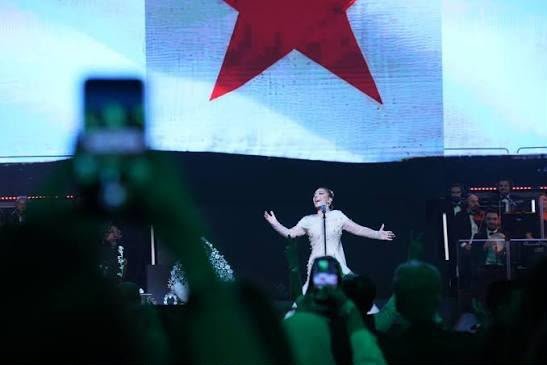
On a September night in 2026, the lights went down at the Al-Fayhaa Sports Hall in Damascus, and a voice that had been absent from Syrian stages for fifteen years filled the air. Asala Nasri — one of the Arab world’s most celebrated singers, and for fifteen years a symbol of cultural resistance to the ousted Assad regime — had come home. Thousands of fans wept, waved Syrian flags, and sang along. Yet even as the music played, another battle was unfolding outside the arena: a fierce struggle over the very soul of post-Assad Syria, fought not with weapons but with fatwas, sermons, and torn posters.
Asala’s concert was far more than an artistic event. It became the first major test of the limits of cultural freedom in a country emerging from half a century of dictatorship, exposing a deepening rift between those who dream of a plural, open Syria and those who seek to impose a rigid, exclusionary vision of its future.
The Concert: A Triumph and a Provocation
Asala Nasri’s return was laden with symbolism. She was among the first Syrian artists to support the peaceful anti-Assad protests in 2011, refusing to perform at government events. For this stance, she was expelled from the Syrian Artists’ Syndicate and subjected to relentless media campaigns. She went into exile, living in Cairo and performing across the Arab world, while her homeland descended into a 13-year civil war that killed more than half a million people.
Her return, then, was never merely a concert. It was a reckoning. Her new album, “The Syrian Album,” featured folk songs from all fourteen of Syria’s provinces — including the Alawite coast and Druze-majority Sweida, both scarred by sectarian violence. Culture Minister Mohammed Yassine Saleh dubbed her “the daughter of Damascus” and joined her on stage, declaring her return that of “every honest Syrian and every free person”. Half of the concert’s proceeds were donated to charity.
For many, the evening represented the cultural renaissance that Syria’s new authorities had promised. The ministry had sponsored the event, tickets sold out within hours, and the show was broadcast extensively. As Asala herself declared from the stage: “Recovery will only happen with art and music”.
The Counter-Campaign: “Cancel the Sinful Concerts”
Yet even before the first note was sung, a parallel campaign was gathering force. Egyptian preacher Hani Dahab, residing in Syria, launched a social media crusade under the slogan “Cancel the Sinful Concerts”. He accused the Culture Ministry of seeking to “give society a secular character”. Syrian Salafi preacher Abdul Razzaq al-Mahdi condemned what he called a “concert of music and debauchery,” while a group of Damascus preachers called on the culture minister to respect “the religious identity of society”.
The campaign was not confined to rhetoric. Posters for the concert were torn down in the streets of Damascus. Friday sermons in mosques across the capital targeted both the concert and the culture minister personally, with some imams describing the event as part of a broader assault on religious values. Theologians and sheikhs who had once been silent under Assad’s repression now found their voices, demanding not merely a say but a veto over the public sphere.
A Nation Divided: The Fault Lines of “New Syria”
The controversy around Asala’s concert exposed a fundamental question: who owns the culture of the new Syria?
On one side stood those who saw the concert as a long-delayed act of national healing. “I never thought this day would come. It’s like a beautiful dream,” said Sawsan Wadha, a 56-year-old concert-goer. “We are very happy that our country is moving forward,” added 40-year-old Lynn Nahas. For these Syrians, the ability to gather in a public hall, to sing, to weep, and to celebrate without fear was itself a victory over the tyranny that had silenced them for decades.
On the other side stood a coalition of conservative religious forces — Salafi preachers, mosque orators, and Islamist activists — who viewed the concert not as liberation but as moral corruption. They argued that public musical performances violate Islamic principles and that the state should reflect the “religious identity” of a predominantly Muslim society. Their campaign was not limited to Asala; it targeted “all musical events across the country” on the grounds that they “contravene religious values”.
This divide is not merely about music. It reflects a deeper struggle over the character of the Syrian state itself: will it be civil, plural, and secular in orientation, or will it be shaped by a religious framework that restricts public cultural expression? The Asala controversy made clear that the fall of the Assad regime did not resolve this question — it unleashed it.
Beyond the Concert: A Cultural Landscape in Flux
The battle over Asala’s concert is only the most visible flashpoint in a broader contest over Syria’s cultural future.
Since the fall of the regime, Syria has witnessed a genuine cultural awakening. The National Museum in Damascus reopened. A documentary about Sednaya prison was screened at the Opera House. The Syrian Symphony Orchestra performed for the first time in years. The Damascus International Book Fair returned with over 500 publishers and 100,000 titles from 35 countries. Kurdish, previously banned, was recognized as a national language, and Nowruz was celebrated openly in Damascus for the first time in modern history. The Syrian Artists’ Syndicate welcomed Asala’s return as reflecting “new beginnings in the country’s cultural scene”.
Yet this renaissance is fragile. Artists report a paradox: the overt security censorship of the Assad era has receded, but new forms of pressure have emerged — bureaucratic hurdles, the need for official permits, and a rising tide of religious conservatism that seeks to police cultural life. The Culture Ministry has denied suspending a play by the Malas Brothers, but the incident raised fears that political criticism of the new authorities could be met with quiet suppression. Visual artists have faced backlash for exhibiting nudes, with some students receiving threats and even “zero grades” for violating religious norms. A concert by renowned composer Malek Jandali was cancelled, and nude drawing was reportedly banned in some institutions.
The Struggle for the Future
The question now is whether Syria’s cultural sector can grow and thrive under these conditions — or whether the rising tide of religious conservatism will suffocate the fragile opening that followed Assad’s fall.
There are reasons for cautious optimism. The new government has invested in cultural infrastructure, signing agreements to develop cultural programs in rural areas and to support children’s and youth activities. A $1.5 billion media and arts production city, “Damascus Gate,” has been announced under presidential patronage. The Culture Ministry has affirmed its commitment to “restore Syria’s leading role on the level of Arab and international culture”.
But there are also reasons for deep concern. The cultural sphere remains without a coherent policy framework. As one analysis put it, Syria is living in a state of “liquid culture” — a culture without constants, moving rapidly, lacking regulatory frameworks, subject to the logic of the moment rather than a long-term vision. The Culture Minister himself has been described as uncertain of his role, oscillating between social media celebrity, religious orator, and civil activist, without seriously confronting the fundamental question: what is culture, and what is the state’s role in it?
Conclusion: A Culture on the Knife’s Edge
Asala Nasri’s concert was never just a concert. It was a mirror held up to a society still struggling to define itself. In the cheers of thousands of fans and the fury of those who sought to silence her, Syrians glimpsed two possible futures: one in which culture is a shared public good, open to all, protected by the state and nourished by diversity; another in which culture is a battleground, policed by religious authority and restricted to those who conform.
The battle over Asala’s stage is far from over. But the fact that she sang — and that thousands stood with her — suggests that the desire for a free cultural life runs deep in Syrian society. Whether that desire can be translated into durable institutions, protected by law and sustained by policy, will determine whether Syria’s cultural spring becomes a lasting season or a brief, beautiful moment before the clouds return. The answer, as always in Syria, remains uncertain — but the music, for now, is still playing.

Subscribe to Our Newsletter
Keep in touch with our news & offers
Merci de vous être abonné(e) à la newsletter.
Oups. Une erreur s'est produite. Veuillez réessayer plus tard.