
1. A Truce Without a Political Settlement
Southern Lebanon remains caught between the language of diplomacy and the realities of military confrontation. The central question is no longer simply whether Israel and Hezbollah can be persuaded to reduce hostilities, but whether the arrangements negotiated under American auspices can establish a security framework that all sides have a reason to respect.
The latest exchanges between Beirut and Washington illustrate the difficulty. On October 15, Lebanese President Joseph Aoun asked US Secretary of State Marco Rubio to press Israel to halt attacks on southern towns and villages, stop land-clearing operations and allow farmers to return to their fields. Aoun also maintained that Lebanese security forces were implementing government decisions to confiscate unauthorised weapons and combat smuggling. The conversation came as Hezbollah acknowledged ownership of a shipment of explosives seized by Lebanese authorities, insisting that the material was intended for operations against Israeli forces rather than domestic targets.
Washington approached the same episode from a different angle. Rubio urged the Lebanese authorities to hold accountable those responsible for the shipment and made clear that the confiscated explosives should not be returned to Hezbollah. The exchange exposed the competing priorities that continue to complicate the diplomatic process: Beirut wants an end to Israeli operations and a restoration of Lebanese sovereignty, Israel wants to prevent Hezbollah from rebuilding its military capabilities, and Washington is pressing the Lebanese state to demonstrate that its authority extends beyond formal declarations.
These objectives are not necessarily irreconcilable, but their sequencing matters. Israel is unlikely to regard a political commitment to disarmament as sufficient without evidence of implementation. Lebanon, meanwhile, faces difficulties in securing public and political support for measures against Hezbollah while Israeli forces remain on Lebanese territory and strikes continue. Hezbollah has used the Israeli presence to justify retaining its weapons, creating a circular argument in which each side presents the other’s actions as a reason not to fulfil its own commitments.
This is the fundamental weakness of the current framework. A ceasefire can reduce violence without resolving the underlying dispute over territory, armed authority and security guarantees. Unless the parties agree on what constitutes compliance, how violations will be verified and what happens when commitments are breached, diplomacy risks becoming a mechanism for managing recurring crises rather than ending them.
2. Washington’s Leverage—and the Limits of American Pressure
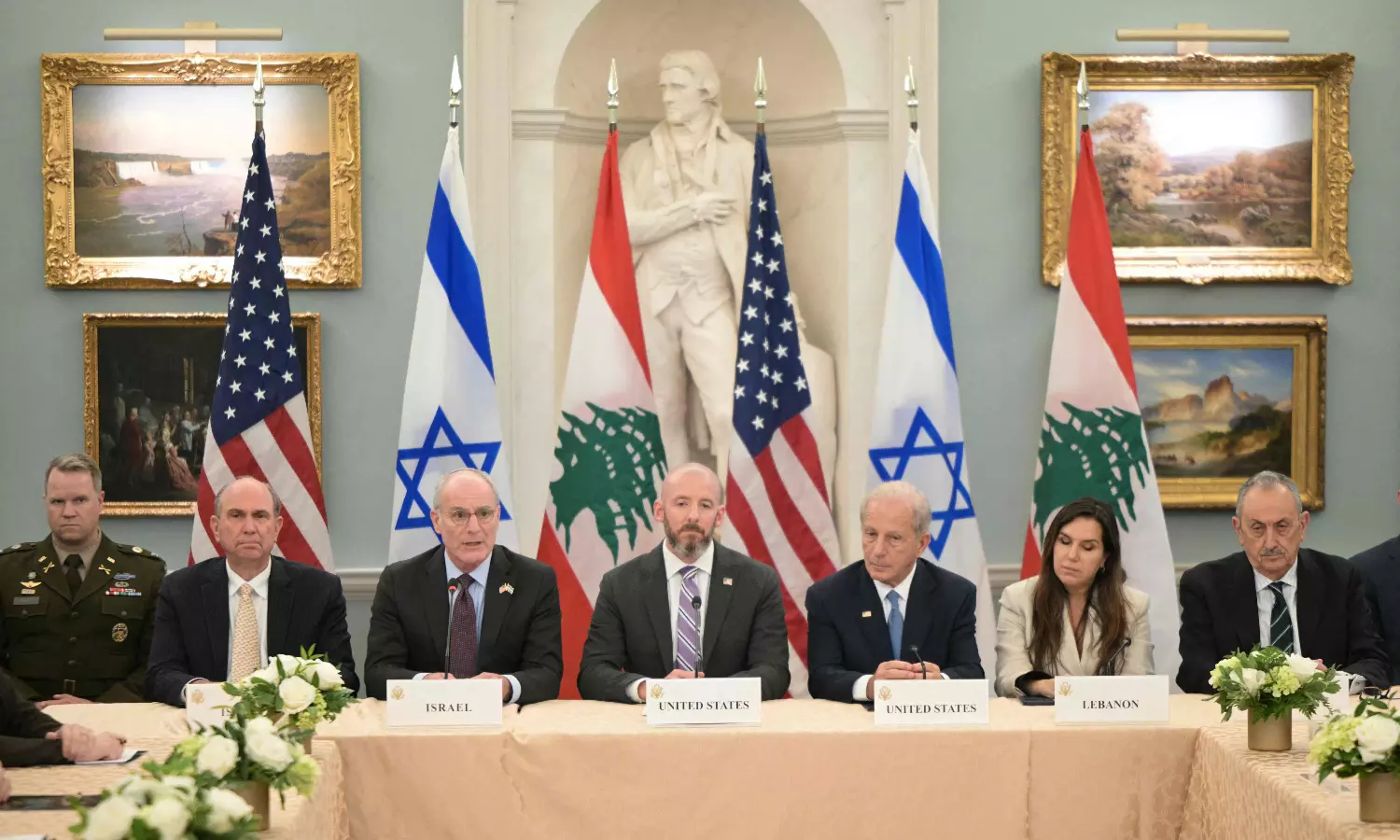
The United States occupies a position that few external actors can replicate. It maintains direct channels with Israeli leaders, has considerable influence over the diplomatic environment surrounding Israel’s security decisions, and can provide political and practical support to Lebanese state institutions. It has also helped bring Lebanese and Israeli representatives into direct diplomatic contact, a significant development given the longstanding absence of normal bilateral relations.
Yet influence should not be confused with control. Washington can press Israel to modify its military posture, but it cannot assume that Israeli leaders will accept arrangements they consider insufficient to prevent future attacks. Nor can American pressure alone compel Hezbollah to surrender its weapons or guarantee that the Lebanese government has the political authority and operational capacity to enforce its decisions throughout the country.
The immediate challenge is therefore one of diplomatic balance. If Washington concentrates on the Lebanese government’s obligations while treating Israeli military actions as a secondary issue, it risks weakening the credibility of the process in Beirut. Conversely, if it demands a halt to Israeli operations without securing meaningful and verifiable measures to prevent Hezbollah from restoring its military infrastructure, it may struggle to persuade Israel that the agreement offers lasting security.
A more effective approach would link obligations on both sides to clearly defined milestones. Lebanese measures against unauthorised weapons and military activity would need to be accompanied by verifiable steps towards Israeli withdrawal, restrictions on offensive operations and arrangements for monitoring the border. Neither side would have to rely entirely on the other’s assurances; progress could instead be assessed against agreed benchmarks.
This would require Washington to do more than facilitate conversations. It would have to invest diplomatic capital in maintaining reciprocal commitments, resolving disputes over alleged violations and ensuring that setbacks did not automatically trigger a return to military action. The distinction is important: mediation helps parties reach an understanding, while implementation requires institutions, monitoring and consequences for non-compliance.
There is also a domestic political dimension. The Lebanese government must demonstrate that its security decisions are being enforced through legitimate state institutions rather than through arrangements that appear selective or externally imposed. If American pressure is perceived as demanding concessions from Beirut without delivering tangible improvements in security and sovereignty, it could undermine the very institutions Washington seeks to strengthen.
The test of American diplomacy, then, is not whether it can secure another declaration of commitment. It is whether Washington can persuade the parties to accept a practical arrangement in which compliance produces visible benefits and violations carry credible costs.
3. The Hezbollah Question: Disarmament, Israeli Withdrawal and State Authority
The dispute over Hezbollah’s weapons lies at the centre of Lebanon’s security dilemma. The Lebanese government has committed itself to bringing unauthorised arms under state control, while Hezbollah maintains that it will not disarm as long as Israeli forces remain on Lebanese territory. Israel, for its part, argues that continued military action is necessary to prevent the group from rebuilding its capabilities and threatening communities across the border.
Each position contains a strategic concern that cannot simply be removed through diplomatic language. Israel wants confidence that the threat posed by Hezbollah will not re-emerge after a withdrawal. Hezbollah seeks to preserve what it describes as a deterrent capability while Israeli forces remain present. The Lebanese state wants to restore its authority over decisions of war and peace without provoking an internal confrontation that could further weaken the country.
The seizure of explosives in the Bekaa region is significant in this context. Hezbollah’s acknowledgement that the shipment belonged to the group, coupled with its demand for the return of the material and the release of those detained, places the government’s disarmament policy under immediate practical pressure. It also raises a wider question about the extent to which the state can enforce its decisions when an armed organisation maintains independent military objectives and supply networks.
The order in which obligations are implemented may prove as important as the obligations themselves. Requiring comprehensive disarmament before any meaningful change in Israel’s military presence could leave the Lebanese government politically exposed. An Israeli withdrawal without credible security arrangements, however, could be viewed by Israel as leaving the underlying threat unresolved. A process that attempts to settle every issue before implementation begins may simply remain paralysed.
A phased arrangement offers one possible way forward. It could combine geographically defined security measures, stronger Lebanese Army deployment, verified restrictions on military activity, agreed steps towards Israeli withdrawal and a mechanism for investigating alleged violations. Progress would be measured against observable actions rather than political statements alone.
Such an arrangement would not resolve the broader question of Hezbollah’s place in Lebanese politics or the future of its military wing. Nor would it guarantee that all parties would comply. Its value would lie in reducing the number of unresolved issues that could immediately trigger renewed fighting, while giving Lebanese institutions greater responsibility for security on the ground.
Ultimately, the challenge is not simply to remove weapons from a particular area. It is to establish a political and security order in which decisions about armed force are made by legitimate state institutions, borders are monitored credibly and civilians are not left to bear the cost of an open-ended confrontation.
4. UNIFIL’s Departure and the Risk of a Monitoring Gap
The future of the United Nations Interim Force in Lebanon (UNIFIL) adds another layer of uncertainty to the negotiations. The UN Security Council has decided not to renew the mission’s mandate beyond the end of 2026, with a withdrawal process expected to continue into 2027. As the deadline approaches, the question of who will monitor the border, report violations and help prevent local incidents from escalating has become increasingly urgent.
UNIFIL’s role has extended beyond maintaining a visible international presence. Its peacekeepers have monitored developments along the Blue Line, maintained liaison channels between the parties, supported humanitarian access and helped reduce the risk of miscalculation. These functions do not eliminate the underlying conflict, but they provide practical mechanisms for managing incidents before they develop into wider confrontations.
The transition is particularly sensitive because the Lebanese Army’s ability to deploy and operate throughout southern Lebanon remains constrained by security conditions, damaged infrastructure, access restrictions and resource shortages. The UN peacekeeping leadership has warned that the departure of the existing mission without robust alternative arrangements could create a significant security vacuum. European proposals to support and train Lebanese forces may help strengthen state institutions, but training assistance is not automatically a substitute for an established peacekeeping operation with monitoring and liaison responsibilities.
This distinction deserves greater attention in the diplomatic debate. A force designed primarily to train and equip Lebanese security personnel would perform a different function from one mandated to monitor developments, maintain operational contact with both sides and support de-escalation. Any transition plan must specify which institution will assume each responsibility, what authority it will possess and how it will respond when access is denied or an alleged violation requires investigation.
The timing matters as well. If the existing mission withdraws while Israeli forces remain in parts of southern Lebanon, Hezbollah’s military activity continues and the Lebanese Army’s deployment remains incomplete, the absence of an accepted monitoring mechanism could make the security environment harder to manage. Competing accounts of incidents would become more difficult to verify, while local commanders could face greater pressure to respond before diplomatic channels have time to intervene.
For Washington, the future of UNIFIL is therefore not a secondary institutional question. It is directly connected to the viability of any security arrangement it hopes to broker. A political agreement without a credible system for monitoring implementation would leave the parties dependent on their own assessments of compliance—the very condition that has repeatedly undermined confidence.
5. Three Paths Ahead: What Would Make De-escalation Sustainable?
The trajectory of southern Lebanon will depend on the interaction between diplomatic decisions, military calculations and the capacity of Lebanese institutions to enforce policy. Three broad scenarios provide a useful framework for assessing the months ahead.
The first is a gradual and monitored de-escalation. Under this scenario, Washington would help secure reciprocal commitments linking a reduction in Israeli operations to measurable Lebanese security steps. The parties would agree on a timetable, a mechanism for investigating alleged violations and arrangements to maintain communication between military authorities. Israeli withdrawal and the deployment of Lebanese forces would proceed according to verifiable milestones, while international monitoring would continue in an agreed form. This would not resolve every political dispute, but it could reduce the immediate incentives for renewed confrontation.
The second is a prolonged period of fragile calm. Diplomatic contacts would continue, and the parties might avoid a return to sustained large-scale fighting, but disagreements over weapons, territory and monitoring would remain unresolved. Isolated strikes, arrests, disputed incidents and restrictions on civilian movement could persist. Such an outcome might provide temporary relief, yet it would leave the underlying security dilemma intact. The key indicators would be the absence of an agreed implementation timetable, continued disputes over compliance and delays in deciding how border monitoring will function after UNIFIL’s mandate expires.
The third is renewed escalation. A major attack, significant civilian casualties or a breakdown in military communication could trigger retaliation and a widening cycle of violence. The risk would be particularly acute if either side concluded that the other was using negotiations to gain time or improve its military position. A monitoring gap following UNIFIL’s departure could further complicate efforts to establish what happened during an incident and contain its consequences. This scenario would become more plausible if diplomatic channels deteriorated, military operations expanded geographically or the parties abandoned agreed procedures for addressing violations.
These scenarios are not mutually exclusive over time. A period of fragile calm could give way to a negotiated arrangement, or deteriorate into renewed confrontation. The decisive question is whether the parties can move from temporary restraint to a system that makes compliance more predictable and escalation less attractive.
Several indicators deserve particular attention. First, does Washington translate its diplomatic engagement into specific, reciprocal commitments rather than relying on general calls for restraint? Second, does the Lebanese Army expand its operational presence and demonstrate that government decisions on weapons and smuggling are being enforced? Third, does Israel take verifiable steps towards withdrawal and restraint in its operations? Fourth, is a credible successor arrangement established before UNIFIL’s withdrawal begins in earnest? Finally, do civilians regain access to agricultural land, essential services and damaged communities? These developments would offer a more reliable measure of progress than the frequency of diplomatic meetings or the tone of public statements.
The humanitarian and economic dimensions are central to the outcome. A truce that leaves farmers unable to reach their land, families unable to return and communities uncertain about reconstruction will struggle to generate confidence in the political process. Civilian recovery should therefore be treated as part of the security arrangement rather than as a benefit to be considered only after military questions have been settled.
The broader conclusion is that American diplomacy has the capacity to help contain escalation, but its success will depend on whether it can bridge the gap between political commitments and implementation. Pressure on Beirut alone cannot guarantee Israeli restraint, just as pressure on Israel alone cannot resolve the question of Hezbollah’s weapons. A sustainable arrangement requires reciprocal obligations, credible monitoring, stronger Lebanese institutions and a clear process for addressing violations.
Southern Lebanon is therefore approaching a consequential test. The issue is not simply whether Washington can broker another pause in the fighting. It is whether the United States and its partners can help establish conditions under which neither side sees renewed military action as the only reliable means of protecting its interests. Until that calculation changes, any truce will remain vulnerable to the next incident—and the next crisis may be harder to contain than the last.
Sources and Further Reading
- Reuters, October 15, 2026, “Hezbollah says it owned confiscated explosives, meant to attack Israel.”
https://www.reuters.com/world/middle-east/hezbollah-says-it-owned-confiscated-explosives-meant-attack-israel-2026-10-15/ - Associated Press, October 15, 2026, “UN peacekeeping chief says major questions hang over southern Lebanon as UNIFIL exit nears.”
https://apnews.com/article/8c84eb54b63eb2d75bd3f595c121d9c6 - Al Jazeera, October 16, 2026, “Rubio presses Lebanon on confiscation of weapons from Hezbollah.”
https://www.aljazeera.com/news/2026/10/16/rubio-presses-lebanon-on-confiscation-of-weapons-from-hezbollah - UN Interim Force in Lebanon (UNIFIL), October 1, 2026, “UNIFIL remains a critical stabilizing factor in south Lebanon.”
https://unifil.unmissions.org/en/news/unifil-remains-a-critical-stabilizing-factor-in-south-lebanon - UK House of Commons Library, September 24, 2026, “Lebanon and the end of UN Interim Force in Lebanon’s mandate in 2026.”
https://commonslibrary.parliament.uk/research-briefings/cbp-10348/
Editorial note: This analysis distinguishes reported developments from strategic interpretation. The scenarios are conditional assessments, not predictions of a particular outcome. Claims by the parties regarding military intentions and violations should be treated as attributed statements unless independently verified.